
What’s Making Feeding So Hard?
Let’s Make Sense of It Together
Eating with EASE helps you move beyond trying one strategy after another and figure out what support actually fits your child.
Created for parents of toddlers through teens navigating selective eating, sensory differences, food rigidity, anxiety around food, neurodivergence, or feeding challenges that just don’t seem to be getting easier.
Get answers to your questions, get unstuck, and find practical next steps that fit your child and family.

Short, self-paced lessons + 3 months of LIVE support created by award-winning Brenda Chilstrom, OTR/L, pediatric occupational therapist and feeding specialist.
✨ Now available through direct access using the Step Up for Students FES-UA scholarship. ✨

Feeding doesn’t just happen at the table.
When your child is struggling to eat, feeding follows you everywhere.
You think about it while you’re grocery shopping.
You wonder whether to make one meal or two.
You pack “safe” foods before leaving the house.
You check restaurant menus before making plans.
You worry about school lunches, birthday parties, vacations, and holidays.
You lie awake wondering whether your child is getting enough nutrition.
You search for answers after everyone else has gone to bed.
And every time someone says,
“They’ll eat when they’re hungry.”
or
“Just stop making a second meal.”
you wonder if you’re somehow getting it wrong.

You don’t need more random feeding advice.
You need a way to make sense of all the pieces that can make eating hard—and how they fit together for your child.
Maybe your child eats only a small group of foods, notices the tiniest change in a familiar food, struggles with certain textures, needs foods served a particular way, or becomes anxious when something feels unfamiliar.
Those patterns can look similar from the outside, but they don’t always come from the same place.
Most feeding advice starts with what to do: offer this, expose them to that, involve them in cooking, serve one familiar food, or keep trying.
Those ideas may be helpful—but only if they match what is actually making eating hard for your child.
If sensory needs are the biggest barrier, the next step may look different than it would for anxiety. If your child needs more support with development, motor skills, predictability, comfort, or capacity, the strategy needs to fit that too.
That’s what EASE is designed to help you sort through.
Why the usual advice doesn’t always work
EASE at a Glance:
Short, self-paced lessons that answer the questions parents are actually asking about feeding
A clear framework for looking beyond the food to make sense of what’s making eating hard
Practical next steps that fit your child, your family, and real life
3 months of LIVE support from me, a pediatric occupational therapist and feeding specialist
See the questions EASE helps answer—and what’s covered along the way.


EASE may be a good fit for your family if…
✓ You’re concerned about your child’s eating but aren’t sure where to begin.
✓ Your child is already in feeding therapy, and you want more clarity and confidence between sessions.
✓ Feeding therapy isn’t available, accessible, or financially possible for your family right now.
✓ You’re looking for a relationship-based approach that moves beyond pressure, rewards, and one-size-fits-all advice.
✓ You want guidance you can return to as your child grows, changes, and encounters new challenges.
You don’t need a diagnosis, a referral, or all the answers before you begin.
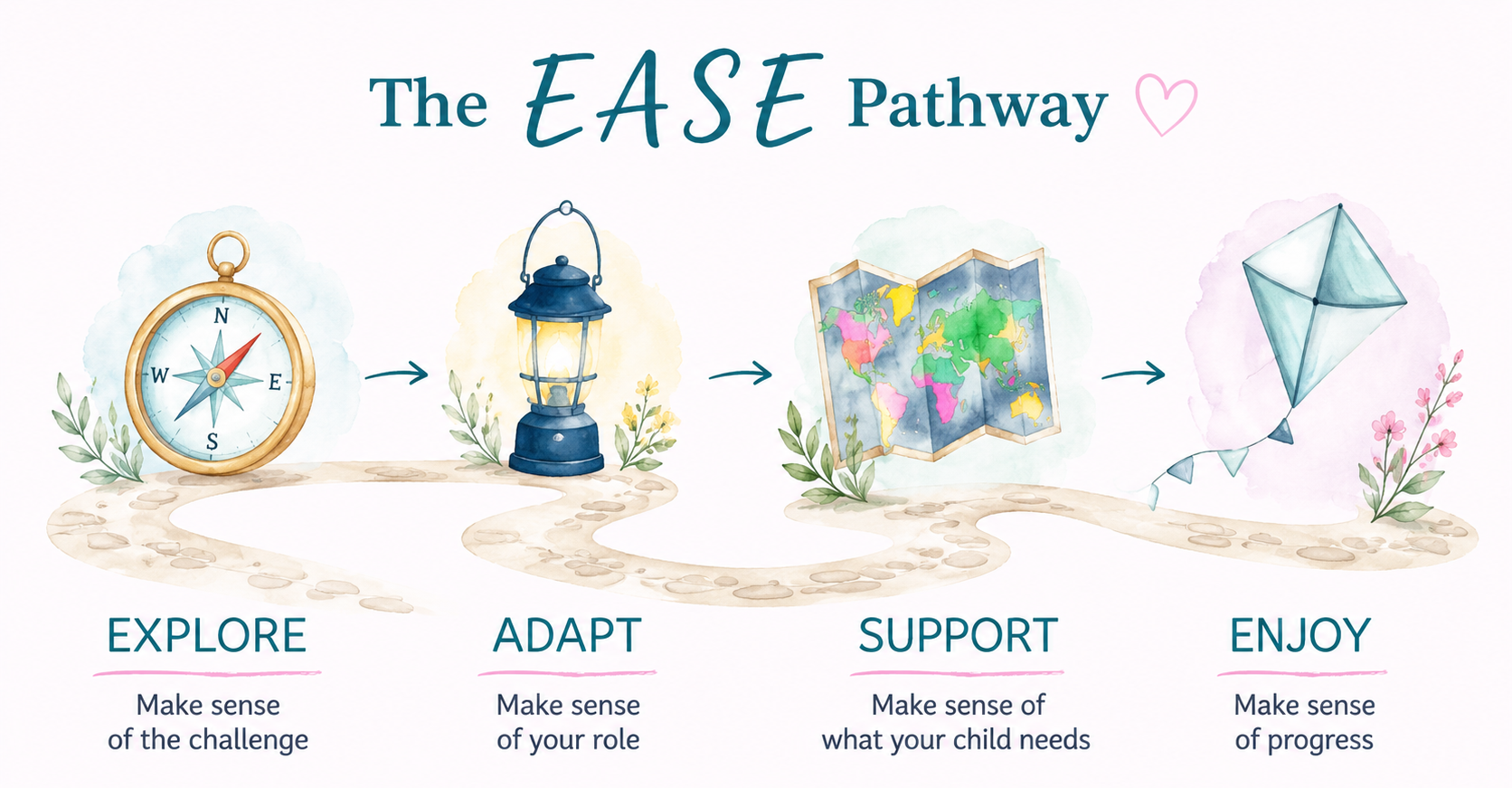

EASE gives you a way to know what to do next
Instead of jumping from one strategy to another, the EASE Framework helps you notice what matters, make thoughtful changes, and choose support that fits your child.
EASE isn’t a checklist or another collection of feeding tips.
EXPLORE
“Why is this happening?”
Begin making sense of the challenge.
You’ll look beyond what is happening on the plate and begin noticing the sensory, developmental, emotional, medical, relational, and environmental factors that may be shaping your child’s eating.
The goal is not to solve everything at once. It is to gather better information before deciding what to do next.

ADAPT
“What can I change?”
Make sense of your role.
You’ll explore how expectations, pressure, routines, language, and everyday interactions can affect what happens around food.
Small changes can create more felt safety, connection, and room for curiosity to emerge.
SUPPORT

“What does my child need most right now?”
Make sense of where to focus.
You’ll learn how to organize what you are noticing and recognize whether your child may need more support with comfort, capacity, capability, development, or another part of the eating experience.
Instead of trying everything, you can choose a next step that fits your child.

ENJOY
“What does progress really look like?”
Make sense of progress.
You’ll begin noticing growth beyond bites: less tension, more communication, increased flexibility, greater participation, and a stronger sense of trust.
The goal is not a perfect eater or a perfect mealtime. The goal is more clarity for you, more security for your child, and more room for connection and enjoyment along the way.
Let’s figure out what can make tomorrow feel a little easier.

Questions EASE Helps You Answer
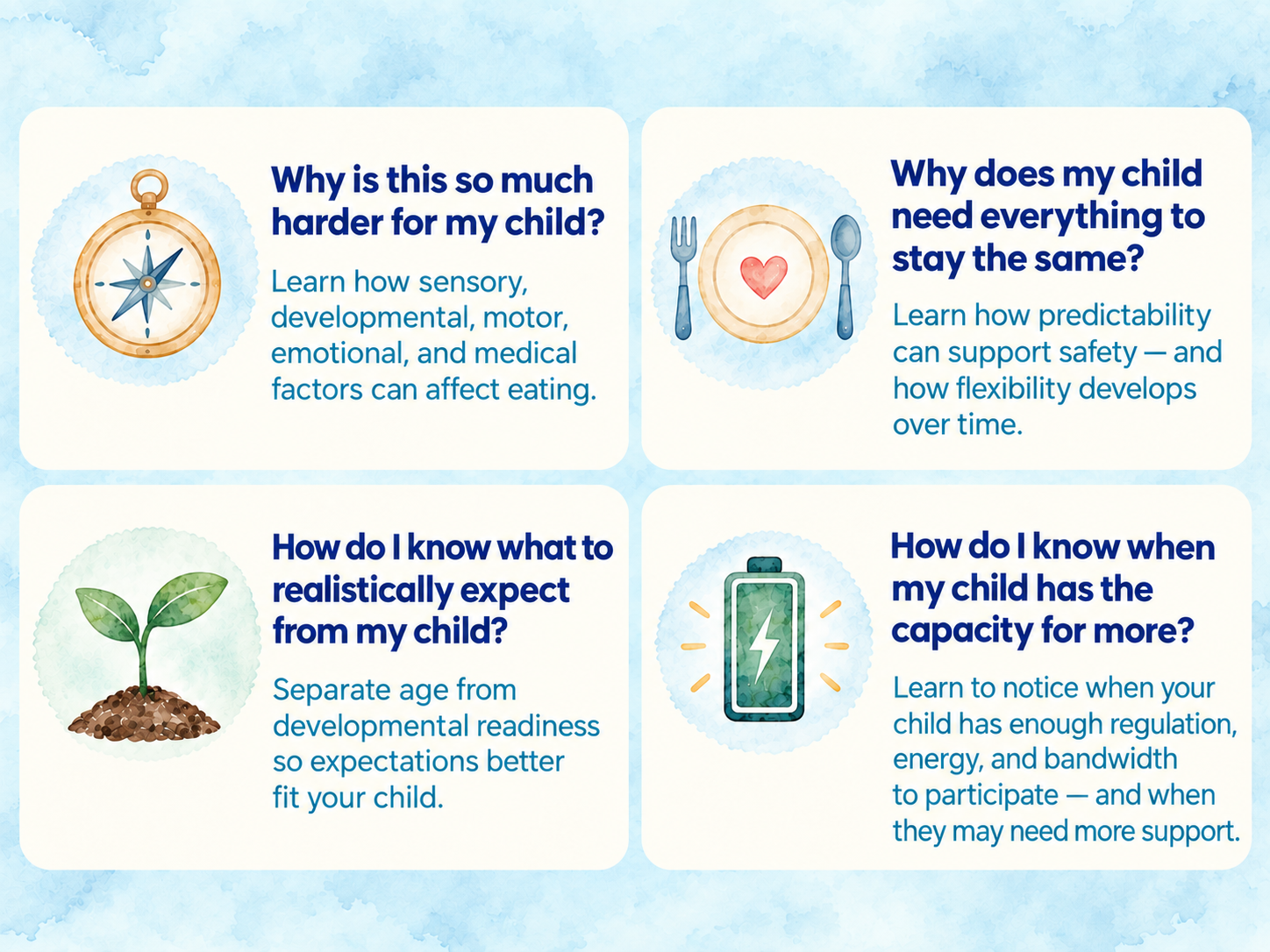
The lessons in EASE are built around the questions parents ask me every day when feeding feels confusing, unpredictable, or stuck.
EASE helps you make sense of things like sensory differences, anxiety, rigidity, readiness, capacity, and feeding skills — without assuming they all need the same solution.

Real families. Real changes.
Families come to EASE with different challenges. Here are a few of the changes parents have noticed along the way.
Before working with Brenda, we had already tried many different therapists and approaches, and we still felt stuck. My son was very rigid about food and believed there was one right way to eat it, including exactly how much he should have.
Brenda helped us stop focusing only on getting him to eat and start looking at what he needed. She used his strengths, took away the pressure, and helped us change how we supported him at home.
Over time, he became more flexible, started listening to his body, and tried foods we never thought he would — including sunny-side-up eggs, pasta with sauce, and dips with new textures.
—Jordan, mom of an 11 year old

“He finally started thinking about food differently.”
My daughter had reflux and food sensitivities, and feeding had been difficult for a long time. Even when some of her medical symptoms were better controlled, eating did not suddenly become easy.
Through our work with Brenda, I began to see how her medical history, comfort, and feeding experiences were all connected. I finally understood why progress could come in waves and why she still needed support even when the medical concerns seemed more stable.
That helped me stop feeling so confused and gave me a much clearer way to support her.
— Anita, mom of an 18-month-old

“For the first time, I understood why feeding was still so hard.”
“I didn’t have to carry so much fear into every meal.”

I was constantly worried about how much my child was eating, and I didn’t realize how much that worry was showing up at the table.
Brenda helped me see what was happening without ever making me feel blamed. She gave me practical ways to take the pressure off and respond differently.
As I became calmer, my child did too. Mealtimes started to feel more connected, and I’m so grateful for the difference it made for our family.
— Parent of a 5-year-old
When feeding starts to make more sense, families begin to move forward with more clarity, confidence, and connection.
Real families don’t have uninterrupted hours to sit down and take a course.
That’s why EASE was designed to fit into the small moments of everyday life.

Learn in bite-sized lessons
The lessons are intentionally short and easy to follow, so you can learn in the moments you already have.
Watch while you’re waiting in carline.
Listen during practice.
Catch a lesson while folding laundry or preparing dinner.
There’s no schedule to keep up with—you can learn at a pace that works for your family and come back to the EASE lessons whenever you need them.

Support to begin putting EASE into practice
As you move through EASE, you’ll have a place to bring questions, celebrate wins, and learn from real-life situations.
Live implementation and Q&A sessions help you apply the framework to your own child and family, with three months of support included in your enrollment.

Resources you’ll return to again and again
EASE includes practical guides, visual tools and downloadable resources to help you apply what you’re learning over time.
Making sense of feeding isn’t something you check off a list.
It’s something you continue building as your child grows and changes.
Support that fits into your life without becoming one more thing competing for your attention.
Everything included with Eating with EASE
✓ Live implementation and Q&A sessions with Brenda
✓ Access to eligible session recordings
✓ Enhanced community resources and support inside Raising Curious Eaters
Bring what happened at dinner, a question about your child’s eating, or something from a lesson that isn’t quite fitting—and we’ll problem-solve together to figure out what may be getting in the way and what to focus on next.
✓ The complete Eating with EASE Academy, including 60+ 8-10 minute lessons
✓ Practical activities and downloadable tools to use with your family
✓ Core Recipe Box resources that support what you’re learning in EASE
✓ Access from your phone, tablet, or computer—so you can come back whenever you need it
PLUS 3 MONTHS OF LIVE SUPPORT
LIFETIME ACCESS
After your three months of included support, you’ll continue to have access to the EASE Academy and the free Raising Curious Eaters community. You may also choose an optional monthly support level for continued live guidance and additional resources.

Ready for feeding to make more sense?

You do not need to have everything figured out before you start.
Your EASE enrollment gives you the framework, resources, and live support to make sense of what your child needs and choose next steps with more confidence.
The Eating with EASE Academy
Lifetime EASE Access + 3 Months of Live Support
$595 paid in full
or
3 monthly payments of $209
✓ Lifetime access to the complete Eating with EASE curriculum
✓ Bite-sized video lessons you can watch from any device
✓ Practical activities and downloadable tools
✓ Full access to EASE curriculum resources in the Recipe Box
✓ Access to the Raising Curious Eaters parent community
✓ Three months of live implementation and Q&A support
✓ Three months of access to session recordings and enhanced community resources
Your purchase includes lifetime access to the Eating with EASE Academy, plus three months of live implementation support and enhanced community access. After that, you’ll continue to have access to the EASE curriculum and the free Raising Curious Eaters community.
The lessons give you the framework.
The resources and live support help you use it in real life.
Using the Step Up For Students FES-UA Scholarship?
Eligible families are able to use scholarship funds toward Eating with EASE through That Makes Sense OT.
Planning to use scholarship funding?
Reach out before enrolling, and we’ll walk through the process together.
Real families. Real results.

“He chose to try it on his own.”
Recently after school, he casually mentioned that he’d eaten pizza with his friends... like it was no big deal. Pizza wasn’t something he typically ate, and no one had prompted or rewarded him to try it.
We’ve been working on taking the pressure off and helping him feel more confident around food. You could have knocked me over when he so casually said he’d eaten pizza.
It gave us so much hope that food might not always be such a struggle for him.
— Erin, mom of a 7 year old boy

-
Absolutely. EASE is designed to complement feeding therapy, not replace it. It helps you make sense of what you are noticing between appointments so you can respond with more confidence at home and get more from the support your child is already receiving.
-
EASE is a helpful place to start. It gives you a framework for looking beyond the food, noticing what may be affecting eating, and deciding what kind of support may fit your child.
-
The strategies inside Eating with EASE are helpful for toddlers and young children who are still developing their eating skills, along with older children up to around age 12 who have anxiety and stress surrounding the feeding process.
-
Yes! EASE was designed specifically to be adaptable for all populations struggling with eating. EASE is not built around one diagnosis. It considers the many factors that can affect eating, including sensory processing, development, feeding skills, emotions, medical history, neurodivergence, relationships, routines, and the environment.
-
Yes! Families using the Step Up for Students FES-UA scholarship may use those funds for services and learning programs through That Makes Sense OT. If you plan to use scholarship funds, we can walk through the process together. Please use the pink button above this section for instructions.
-
You won't get one generic plan that assumes every child needs the same thing. EASE helps you narrow down what is making eating hard for your child, choose a practical place to start, and bring your questions to LIVE support when you're unsure what to do next.
-
Your enrollment includes ongoing access to the Eating with EASE Academy and EASE curriculum resources. You’ll also receive three months of live implementation and Q&A support, session recordings, and enhanced community access. After that, you’ll continue to have access to the EASE curriculum and the free Raising Curious Eaters community.
-
Some families benefit from more personalized guidance. Individual consultation, coaching, and therapy options may be available depending on your needs and location.
-
After you enroll, you’ll receive instructions for accessing Eating with EASE inside the Raising Curious Eaters online community. That is where you’ll find the Academy lessons, EASE curriculum resources, session recordings, live support details, and parent community.
Your enrollment includes ongoing access to the EASE curriculum, along with three months of live implementation and Q&A support and enhanced community access.

Questions you might still have…
Recognized for Care That Puts Relationships First
Brenda Chilstrom, OTR/L
Brenda is a pediatric occupational therapist and feeding specialist with more than 30 years of experience supporting children and families. Her relationship-first, regulation-informed approach has earned recognition including the 2025 Early Intervention Master Clinician Award and multiple Best of Naples honors.
EASE brings together what she has learned from decades of helping families make sense of complex feeding challenges and find a more confident way forward.


Four-Time Winner
Best of Naples Occupational Therapy

Before you go…
If feeding has felt confusing or exhausting, it makes sense that you’ve been searching for answers.
You may have tried different strategies, read the articles, and still felt unsure about what will actually help your child.
Eating with EASE was created to help you make sense of the sensory, developmental, medical, emotional, and relational pieces that can shape your child’s eating experience.
When those pieces begin to make sense, you can carry less pressure into meals and move forward with more clarity and confidence.
You do not need to have all the answers before taking the next step.
I would be honored to help you find a clearer way forward.
— Brenda Chilstrom, OTR/L
Founder, That Makes Sense OT


Get started with Eating with EASE and find the clarity, support, and next steps you’ve been looking for.
Ready to begin?
Live support, practical resources, short lessons when you need them most, and more hope for what comes next.
Copyright 2026-Brenda Chilstrom